Fixing Yard Grading and Drainage Before the Next Heavy Rain
Water goes where the ground tells it to, and in red clay country that is often exactly where you don't want it.
October 16, 2026 · 4 min read
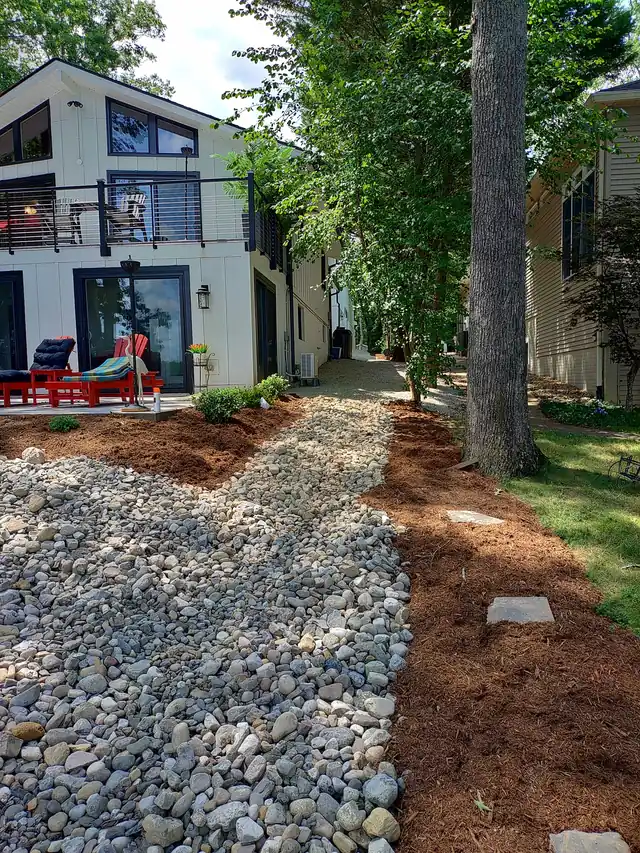
Walk your yard the day after a hard rain. If there's a puddle by the back steps, a dark band of wet soil along the foundation, or mulch washed out into the lawn, the ground is telling you where the water wants to go. In Central Virginia, a lot of that has to do with the soil. Red clay drains slowly, so water that doesn't soak in has to go somewhere, and it takes the path of least resistance.
Signs your grade is working against you
- Water standing in the lawn for a day or two after rain
- Wet soil, mildew smells or damp walls near the foundation
- Small channels cut into bare soil, or mulch and soil washed out of beds
- Soggy low spots that stay soft while the rest of the yard dries
- Water running toward the house instead of away from it
None of these fix themselves. Every storm repeats the damage, and clay that stays saturated also puts more pressure on trees and foundations over time.
Grade away from the house first
The most important stretch of ground is the first several feet next to the house. The soil there should fall gently and steadily away from the walls, so rain runs off rather than into the foundation. Over the years, soil settles beside a house, mulch gets piled higher each spring and beds get built up against the wall. A yard that once sloped away can end up tilting the wrong way. Re-establishing that slope usually means pulling back the buildup, adding fill where the ground is low, and shaping the surface so it carries water to a safe outlet.
Moving water away from one spot only helps if there's a place for it to end up. That might be a natural low area, a ditch, a culvert or a rain garden. Pointing it at a neighbor's yard or into a pool at the property line trades one problem for another. A good grading plan starts at the outlet and works backward toward the house, which is why it helps to have someone look at the whole property rather than just the soggy corner.
Dry creek beds that actually work
A dry creek bed is a shallow shaped channel lined with river rock that carries runoff along a route you picked. Done well, it looks like a landscape feature and works like a drain. The channel is graded so water keeps moving, landscape cloth goes underneath so the soil doesn't work up into the stone and weeds don't come through, and the rock is sized so a heavy flow doesn't wash it away. You can see one in the photo with this post, a river-rock channel beside fresh mulch at a lake house.
Top soil, mulch and the right slope
Top soil fills low spots and builds the base that grass or new plantings need, since clay alone is hard on roots. Mulch protects the surface of a bed from the pounding of heavy rain, slows runoff and keeps the soil beneath from crusting over. Keep it a few inches back from tree trunks and the house wall, and don't let it build up year after year until the bed sits higher than the lawn.
Hand-shoveling can move a wheelbarrow of dirt. It can't shape a yard. A compact machine like a bobcat can push, level and tamp fill across a space quickly, working in tight spots close to the house where a bigger excavator wouldn't fit. The point isn't speed for its own sake. It's that grade is a matter of fine adjustments, and a smooth, consistent slope is the thing that keeps water moving and prevents new low spots from forming.
Linda Futato, in a testimonial on Premier Arbor Services' website, described her yard project this way: “He brought in river rock… landscape cloth, top soil, and mulch. He trimmed, graded, brought in a bobcat to level the dirt, and transplanted some bushes. And the best part? He returns text messages and keeps you notified!”
Grading near trees needs care. Cutting down the soil level near a trunk severs roots, and piling fill against it can smother them. If a mature tree is close to where the water needs to go, plan the channel around the root zone instead of through it. Trees also help: a healthy canopy and a good root system soak up a lot of water that would otherwise run across the yard.
Do it before the rain, not after
Piedmont summers bring heavy thunderstorms, and spring is wet. Drainage work done in a dry week is easier on the ground and on the crew, and the fix is in place before the next downpour tests it. Premier Arbor Services handles drainage and yard grading alongside landscaping, hardscaping and excavating, so the same crew can do the grading, bring in the rock and mulch, and plant the bushes.
If your yard holds water, call (540) 718-3794 and ask for a free estimate. Scott Keen is on each and every job the entire time, and Premier serves Locust Grove, Orange, Bumpass, Spotsylvania, Fredericksburg, Lake Anna, Lake of the Woods and the surrounding area.
Premier Arbor Services LLC, (540) 718-3794
Call (540) 718-3794More articles
How a Walk-Through Sorts Which Trees Come Down Now and Which Can Wait
Most properties hold a mix of urgent trees, borderline trees and perfectly healthy ones, and telling them apart is the whole job.
Clearing Acreage Without Losing the Trees Worth Keeping
The best cleared lots are the ones where the right trees were chosen before any equipment moved.